

There is a particular kind of panic that sets in about 48 hours before a new dog arrives home. You know you need things — bowls, a leash, food — but the sheer volume of pet products available makes narrowing it down feel genuinely overwhelming. Walk into any large pet store and you will find an entire aisle dedicated to leashes alone. The decisions multiply fast.
The truth is that not everything marketed to dog owners is something your dog actually needs. Some products are genuinely essential from day one. Others are useful but not urgent. And some are clever marketing dressed up as necessities. Knowing the difference saves you money, reduces clutter, and ensures your dog’s real needs are covered before anything else.
This guide cuts through the noise. Every item on this checklist has been selected based on practical value to your dog’s daily health, safety, comfort, and quality of life. Whether you are bringing home a puppy or adopting an adult dog, this is the resource to work through before your new dog walks through the door.
Quick Answer
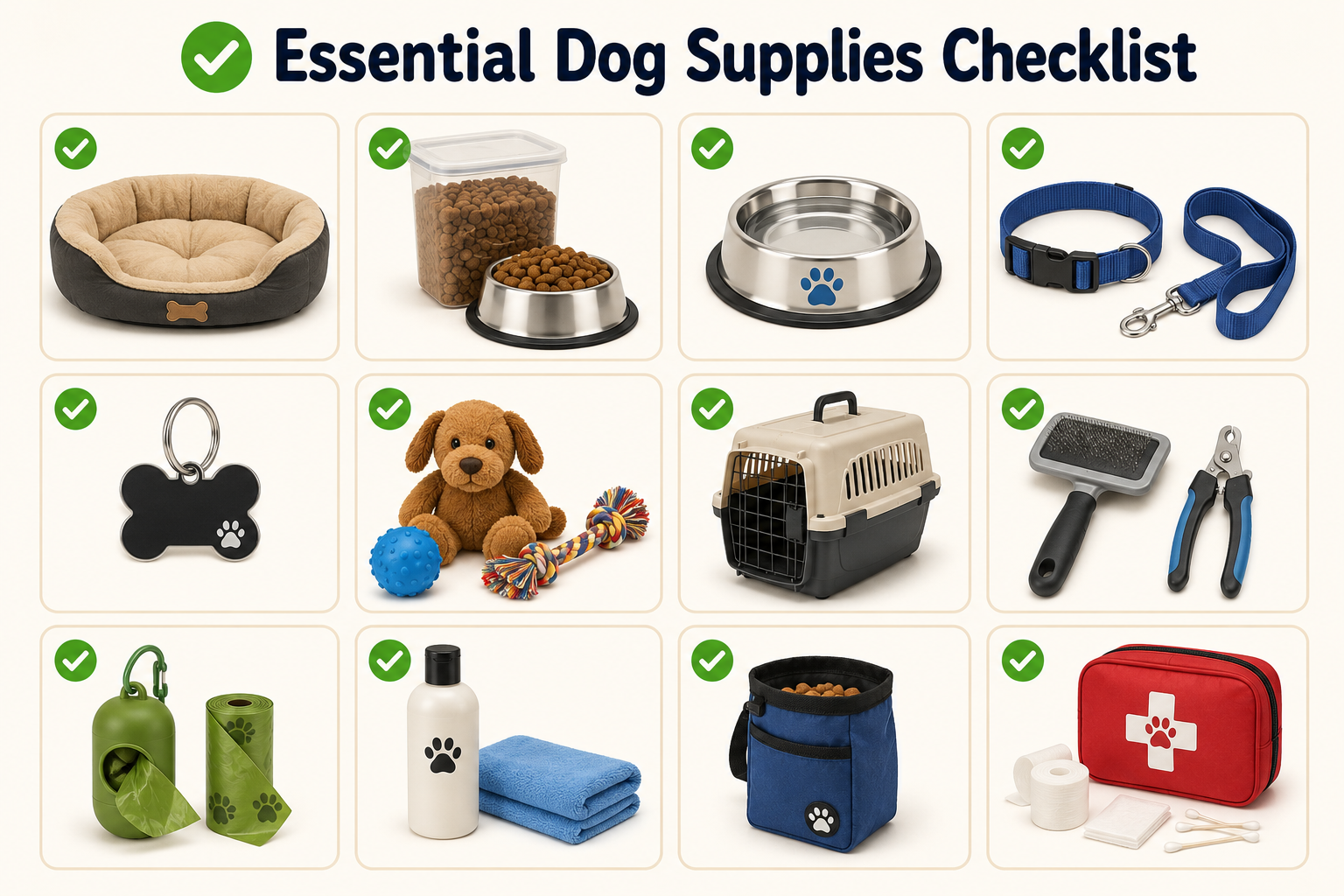
The essential dog supplies every new owner needs before bringing a dog home include food and water bowls, age-appropriate dog food, a collar with an ID tag, a leash, a harness, a crate, a dog bed, a brush, dog shampoo, nail clippers, poop bags, enzymatic cleaning spray, chew toys, and a basic first aid kit. Puppies additionally need training pads, baby gates, teething toys, and puppy-specific food and shampoo.
Why Every Dog Owner Needs a Supplies Checklist
Bringing a dog home without preparation creates unnecessary stress for both of you. A dog arriving in a home that has no bed, no appropriate food, and no structured space is immediately at a disadvantage. Their first impressions of their new environment are formed in those first few hours, and the quality of that experience matters.
Beyond the dog’s well-being, preparation protects your home. An unsupervised puppy in an un-puppy-proofed space with no appropriate chew toys will find their own entertainment — usually involving your furniture, baseboards, or charging cables. Having the right supplies in place from the start prevents the kind of frustrated first week that leads some owners to question whether they made the right decision.
A checklist also prevents the specific kind of frantic pet store trip that happens at 9 PM on your dog’s first night home when you realize you forgot to buy poop bags, have no cleaning spray for the accident that just happened, and your dog has been chewing your shoe for twenty minutes because you did not think to buy chew toys.
Work through this list before your dog arrives. You will be significantly more prepared — and so will your home.
Essential Dog Supplies at a Glance
| Category | Essential Items |
|---|---|
| Feeding | Food bowl, water bowl, dog food, treats, treat container |
| Walking | Collar, harness, leash, ID tag, poop bags |
| Sleeping | Dog bed, crate, crate mat, blanket |
| Grooming | Brush, shampoo, nail clippers, ear cleaner, toothbrush, dog toothpaste |
| Health and Safety | First aid kit, pet thermometer, tick remover, flea comb |
| Cleaning | Enzymatic stain remover, odor eliminator, lint roller |
| Toys | Chew toys, puzzle toys, fetch toys, interactive toys |
| Puppies | Training pads, baby gates, puppy pen, teething toys, puppy food |
| Travel | Travel crate or harness, travel bowls, portable water bottle |
| Optional | GPS tracker, automatic feeder, water fountain, dog camera |
Feeding Essentials
Food Bowl
Stainless steel food bowls are the most practical choice for most dogs. They are durable, dishwasher-safe, resistant to bacterial biofilm buildup, and do not leach chemicals the way some lower-quality plastics can over time. Ceramic bowls work well but can chip, creating sharp edges and potential ingestion hazards.
Avoid deep-sided bowls for flat-faced (brachycephalic) breeds like Bulldogs, Pugs, and French Bulldogs — their anatomy makes eating from deep bowls uncomfortable. Shallow, wide bowls work better for these breeds.
For large, deep-chested breeds prone to bloat — including Great Danes, German Shepherds, and Dobermans — raised feeding stations are sometimes recommended, though current veterinary evidence on their effectiveness for bloat prevention is mixed. Discuss this with your vet for breed-specific guidance.
Buying Tip: Purchase at least two food bowls — one for regular meals and a backup for when the primary is in the dishwasher.
Water Bowl
Use a separate water bowl from the food bowl, and keep it filled with fresh, clean water at all times. Heavy ceramic or stainless steel options are harder for smaller dogs and puppies to tip over. Clean water bowls thoroughly every two to three days — bacteria form a slippery biofilm inside bowls more quickly than most owners realize.
Puppy Food
Puppies have significantly different nutritional needs than adult dogs. Puppy foods are formulated with higher protein, fat, and specific calcium-to-phosphorus ratios to support rapid growth. Look for an AAFCO nutritional adequacy statement confirming the food is complete and balanced for growth. Large breed puppies specifically require large breed puppy formulas — the calcium and phosphorus ratios in standard puppy food can contribute to developmental orthopedic disease in rapidly growing large breeds.
Buying Tip: Before bringing your puppy home, find out what food they have been eating and start with the same brand. Transition to a preferred food gradually over seven to ten days to avoid gastrointestinal upset.
Adult Dog Food
Adult dog food should carry an AAFCO statement for maintenance or all life stages. The first ingredient should be a named animal protein — chicken, beef, salmon, or similar. The World Small Animal Veterinary Association recommends choosing foods manufactured by companies with established quality control processes, on-staff veterinary nutritionists, and a history of nutritional research.
Treat Container
A dedicated treat container keeps training treats fresh, accessible, and separate from regular food. A small belt pouch or treat bag is invaluable during training sessions when you need treats immediately accessible without fumbling through a bag.
Travel Water Bottle
A portable dog water bottle with an attached trough allows you to offer water on walks without carrying a separate bowl. These are genuinely useful on any walk longer than 20 minutes, particularly in warm weather.
Buying Tip: Look for a bottle with a lockable drinking trough that prevents water from spilling in your bag between uses.
Walking Essentials
Collar: A flat-buckle collar is the standard starting point for most dogs. It should fit with enough snugness that two fingers slide underneath but not so loosely that it slips over the dog’s head. Check the fit weekly for growing puppies — they outgrow collars faster than owners expect. Breakaway safety collars are appropriate for dogs that spend time off-leash, as they release under pressure to prevent strangulation if caught on something.
Harness: A well-fitted harness distributes leash pressure across the chest and shoulders rather than the throat, making it a safer option for dogs with tracheal sensitivity, brachycephalic breeds, and any dog that pulls on a leash. Front-clip harnesses redirect pulling dogs back toward you rather than allowing them to drag forward. Measure your dog’s chest girth carefully before purchasing — harness sizing varies significantly between manufacturers.
Leash: A standard four to six foot leash in nylon, leather, or biothane provides reliable control and is the appropriate starting point for all dogs. Leather leashes soften with use and are comfortable on the hands. Nylon is affordable and easy to clean. Biothane is waterproof and especially practical for muddy environments.
Retractable Leash: Retractable leashes are not recommended for general daily use. They train dogs to pull by consistently rewarding it with forward movement, provide limited control in unexpected situations, and the cord can cause rope burn injuries to handlers and other dogs. If used at all, retractable leashes are best reserved for well-trained adult dogs in quiet, open environments — not for puppies or dogs in training.
ID Tag: Non-negotiable. Every dog should wear an engraved ID tag on their collar at all times, displaying your name and at least one current phone number. If your dog escapes, an ID tag is the fastest route to reunion. Keep the information current — an old phone number on a found dog’s collar is a wasted opportunity.
Poop Bags: Always carry more than you think you need. Biodegradable options are widely available and are a more responsible environmental choice. Many municipalities legally require dog waste pickup in public spaces.
Waste Bag Holder: A small leash-clip waste bag dispenser keeps bags accessible without hunting through your pockets on every walk.
Reflective Gear: A reflective collar strip, vest, or leash attachment significantly improves visibility during early morning, evening, and nighttime walks. Road traffic is the most preventable cause of dog fatalities outdoors — anything that makes your dog more visible to drivers is worth the minimal cost.
Sleeping Essentials
Dog Bed: Choose a size that allows your dog to stretch out fully. Dogs have different sleeping preferences — some like to curl up in a bolster bed with raised edges, others prefer flat mats. Observe your dog’s natural sleeping position in the first week and adjust accordingly. Washable beds with removable covers are strongly preferred over beds that cannot be laundered.
Blankets: A few washable fleece blankets give your dog something soft and comforting in their sleeping area. In the first week, a blanket with your scent provides additional reassurance.
Crate: A crate is one of the most important tools available to a new dog owner. It supports house training, provides a safe resting space, prevents destructive behavior during unsupervised periods, and gives your dog a den-like retreat. Choose a size that allows your dog to stand, turn around, and lie down comfortably. For puppies, purchase a crate sized for their adult proportions and use an included divider panel to reduce the usable space — a crate that is too large undermines potty training because puppies will eliminate in one corner and sleep in another.
Playpen: An exercise pen allows your dog safe, contained space to move freely when direct supervision is not possible. For puppies especially, an exercise pen attached to the crate creates a larger “home base” area that feels less restrictive while still keeping them safely contained.
Crate Mat: A comfortable crate mat provides cushioning and warmth inside the crate. Choose a machine-washable option with a non-slip backing.
Cooling Mat: Pressure-activated cooling mats do not require refrigeration and provide a comfortable cool surface for dogs prone to overheating — particularly heavy-coated breeds and brachycephalic dogs in warm climates.
Orthopedic Bed: For large breeds, senior dogs, and dogs with diagnosed joint conditions, an orthopedic memory foam bed significantly reduces pressure point discomfort and supports joint health. This is an investment worth making early for breeds predisposed to hip dysplasia and arthritis.
How to Choose the Right Size: Measure your dog from nose to base of tail while they are lying in their natural sleeping position. Add four to six inches to that measurement for the minimum bed length. For crates, follow the manufacturer’s breed and weight guides, but always verify against your individual dog’s actual dimensions.
Grooming Supplies
Brush: Brush type depends entirely on coat type. Slicker brushes work for most medium-length coats. Bristle brushes are appropriate for smooth, short-coated breeds. Undercoat rakes and deshedding tools are necessary for double-coated breeds. Pin brushes work for longer, fine coats. Purchase the correct type rather than a generic “all-breed” brush, which often performs poorly for anything outside average coat types.
Comb: A stainless steel grooming comb is useful for checking that brushing has removed all tangles, particularly around the ears, legs, and tail base where matting commonly starts.
Dog Shampoo: Use only dog-specific shampoo. Human shampoo is formulated for a human skin pH of approximately 5.5, while dogs have a skin pH closer to 7. Using human products disrupts the canine skin barrier and can lead to irritation and increased susceptibility to infection. Choose a gentle formula appropriate for your dog’s coat type and skin sensitivity.
Conditioner: Long-coated and double-coated breeds benefit from a dog-specific conditioner after bathing to reduce tangling and ease brushing. For short-coated breeds, conditioner is optional.
Nail Clippers: Regular nail trimming is essential for your dog’s comfort and gait. Overgrown nails alter the way a dog’s weight is distributed across their paw, which can contribute to joint pain over time. Scissor-style clippers give more control for beginners. Guillotine-style clippers are preferred by many groomers for larger nails.
Nail Grinder: An electric nail grinder smooths sharp edges after clipping and is a useful alternative for dogs that are sensitive to the pressure of clipper blades. Introduce grinders gradually — the vibration and sound require desensitization for most dogs.
Ear Cleaner: A vet-approved ear cleaning solution and cotton balls allow safe outer ear canal cleaning. Never insert cotton swabs into the ear canal — this pushes debris deeper and risks damaging the eardrum. Clean ears when you see visible wax buildup or mild debris, and always after swimming.
Toothbrush: A dog-specific toothbrush — either a traditional handled style or a finger brush — is essential for home dental care. The American Animal Hospital Association considers dental disease one of the most prevalent health conditions in companion animals, with a high proportion of dogs showing some degree of periodontal disease by age three. Daily brushing is the most effective preventive measure available.
Dog Toothpaste: Always use dog-formulated toothpaste. Human toothpaste contains fluoride and often xylitol — both toxic to dogs. Dog toothpastes come in palatable flavors including chicken, beef, and peanut butter, which makes the brushing process significantly more cooperative.
Towels: Designate two or three towels specifically for your dog. Microfiber towels absorb water more quickly than standard cotton towels and dry faster between uses.
Grooming Wipes: Pet-safe grooming wipes are useful for quick clean-ups between baths — wiping paws after muddy walks, cleaning facial folds in brachycephalic breeds, and freshening the coat between full grooming sessions.
Health and Safety Supplies
First Aid Kit: A basic canine first aid kit should include sterile gauze pads, self-adherent bandage wrap, antiseptic wipes, a digital rectal thermometer, blunt-tipped scissors, tweezers, styptic powder for nail bleeds, a disposable syringe for wound flushing, and your veterinarian’s contact number alongside the ASPCA Animal Poison Control Center number (888-426-4435). The American Veterinary Medical Association provides guidance on building a comprehensive pet first aid kit.
Tick Remover: A fine-tipped tick removal tool allows safe removal of embedded ticks without squeezing the body, which can increase disease transmission risk. Your vet or local extension service can advise on tick-borne disease risks in your specific geographic region.
Flea Comb: A fine-toothed flea comb allows inspection for fleas and flea dirt — small dark specks that turn reddish when wet, indicating flea presence. Use alongside vet-recommended flea prevention rather than as a replacement for it.
Pet Thermometer: A normal rectal temperature for dogs ranges between 101 and 102.5 degrees Fahrenheit. A digital rectal thermometer allows you to check for fever at home before calling your vet. Ear thermometers designed for pets are also available, though rectal readings are generally considered more accurate.
Medications: Work with your veterinarian before your dog arrives to determine which preventive medications are needed — heartworm prevention, flea and tick prevention, and any prescription medications for specific health conditions. Do not purchase over-the-counter preventive products without veterinary guidance, as product safety and efficacy vary considerably and some products carry toxicity risks for certain dog sizes and breeds.
Emergency Contact Card: Keep a physical card in your dog’s travel bag and photographed in your phone with your veterinarian’s number, the nearest 24-hour emergency veterinary clinic, and the ASPCA Animal Poison Control Center number.
Microchip Information: If your dog is not yet microchipped, schedule this at the first vet visit. If they are already chipped, verify that the chip registration is in your name with your current contact information. A microchip is only useful if the registry record is current and accurate.
Cleaning Supplies
Pet Stain Remover: Enzymatic cleaners are the only effective option for pet accidents. They break down the urine proteins responsible for both the stain and the residual odor. Standard household cleaners may remove visible staining but leave enough odor for your dog to detect, drawing them back to the same spot. Keep a bottle in every room during the early house training period.
Odor Eliminator: A separate odor-neutralizing spray is useful for general pet smell management on bedding, furniture, and car seats. Choose pet-safe formulas free of essential oils like tea tree and eucalyptus, which are toxic to dogs.
Paper Towels: In large quantity. You will use more than you expect in the first few weeks.
Lint Roller: Dog hair manages to appear in places that seem physically impossible. A quality lint roller on your coat rack, in your car, and near your front door saves considerable frustration.
Cleaning Wipes: Pet-safe multi-surface cleaning wipes allow quick sanitization of food bowls, crate surfaces, and hard floors between deeper cleaning sessions.
Storage Containers: Airtight food-grade containers keep dry kibble fresh significantly longer than leaving it in the original bag. Choose containers sized to hold a full bag of your dog’s food and label clearly with food type and expiry date.
Toys and Mental Enrichment
Chew Toys: Chewing is a natural, self-soothing, and mentally engaging behavior for all dogs. Providing appropriate chew toys redirects this drive away from your furniture and belongings. Choose toys appropriate for your dog’s size and chewing intensity — a determined power chewer can break down soft rubber toys quickly, creating ingestion hazards. Replace any toy that becomes significantly damaged.
Puzzle Toys: Food-dispensing puzzle toys require your dog to problem-solve to access a reward. The mental effort involved is genuinely tiring and helps prevent boredom-driven behavior. Start with easier difficulty levels and increase complexity as your dog becomes more confident.
Fetch Toys: Tennis balls, rubber balls, and soft discs provide high-energy interactive exercise. Choose sizes appropriate for your dog’s mouth — balls too small are choking hazards, balls too large are difficult to carry.
Interactive Toys: Tug ropes, flirt poles, and similar toys require direct interaction with you. These toys meet physical exercise needs while simultaneously strengthening your bond through play.
Rope Toys: Rope toys satisfy the urge to chew and tug, but monitor for fraying — swallowed rope fibers can cause intestinal obstructions. Replace rope toys when they begin to unravel significantly.
Treat Dispensing Toys: Hollow rubber toys that can be stuffed with food and frozen are among the most versatile and useful tools available to dog owners. They provide extended mental engagement, help dogs settle during alone time, and can be used to create positive associations with the crate.
Puppy Essentials
Training Pads: Useful for very young puppies and apartment-dwelling owners who cannot get outside immediately. However, relying exclusively on training pads can slow outdoor house training. If used, transition gradually from indoor pads to outdoor elimination as your puppy’s bladder capacity develops.
Baby Gates: Baby gates restrict access to areas where your puppy should not yet roam unsupervised — staircases, rooms with hazards, and spaces you want to keep dog-free. Pressure-mounted gates work for most doorways. Hardware-mounted gates are recommended for staircases where a gate failure could result in a fall.
Puppy Pen: An exercise pen creates a safe, contained area for your puppy when direct supervision is not possible. Combined with a crate, it provides a home base that feels spacious without exposing your puppy to the whole house unsupervised.
Soft Toys: Soft plush toys provide comfort, particularly for young puppies who miss the warmth and companionship of their littermates. Choose toys with no small detachable parts — button eyes, sewn-on accessories, and ribbons are swallowing hazards.
Teething Toys: Puppies begin losing their baby teeth and growing adult teeth between roughly 12 and 24 weeks. Teething causes gum discomfort that drives intense chewing. Teething-specific toys — often designed to be chilled in the refrigerator for additional relief — help manage this phase appropriately.
Puppy Training Treats: Very small, soft treats that can be swallowed quickly allow fast reward delivery during training without interrupting the learning momentum. Look for treats with simple ingredient lists.
Puppy Shampoo: Puppy-specific shampoos are formulated to be gentler and tearless, accounting for the sensitivity of a young puppy’s skin and the likelihood of shampoo getting near their eyes during their first bath experiences.
Travel Supplies
Car Seat Belt: A crash-tested dog seatbelt harness attaches to your car’s existing seat belt system and prevents your dog from becoming a projectile in sudden stops or collisions. The Center for Pet Safety has conducted crash testing on pet restraint products — look for products with verifiable third-party safety testing rather than unsubstantiated marketing claims.
Travel Crate: For dogs that travel in cargo areas or on airline flights, a well-ventilated, airline-approved hard-sided crate provides the most protection. Ensure the crate is appropriately sized and familiarize your dog with it through gradual desensitization well before any travel.
Travel Bowl: Collapsible silicone bowls are lightweight, packable, and easy to clean — ideal for hikes, road trips, and day outings where carrying regular bowls is impractical.
Travel Bag: A dedicated bag for your dog’s travel supplies — food, medications, health records, vaccination certificates, bowls, waste bags, and a familiar toy — ensures everything is ready and organized when you need it.
Portable Water Bottle: A single-piece portable water bottle with an integrated drinking trough is one of the most practical travel investments for any dog owner.
Dog Seat Cover: A waterproof, non-slip seat cover protects your car’s upholstery from mud, fur, and wet dog smell. Hammock-style seat covers that stretch between the front and back seats also prevent dogs from falling into the footwell during braking.
Seasonal Dog Supplies
Summer Essentials
| Item | Purpose |
|---|---|
| Cooling mat | Provides a cool resting surface for overheating dogs |
| Portable water bottle | Ensures hydration during warm-weather walks |
| Paw balm | Protects pads from hot pavement burns |
| Dog sunscreen | For dogs with thin coats or light-colored noses (vet-approved formulas only) |
| Cooling vest | Helps regulate body temperature during outdoor activity |
Winter Essentials
| Item | Purpose |
|---|---|
| Dog coat or sweater | Provides warmth for short-coated and small breeds |
| Dog boots | Protects paws from ice melt chemicals and frostbite |
| Paw balm | Soothes cracked and chapped paw pads in cold, dry weather |
| Reflective vest | Essential for reduced daylight hours during winter months |
Rainy Season Essentials
| Item | Purpose |
|---|---|
| Dog raincoat | Keeps dog dry and reduces wet-dog smell indoors |
| Waterproof dog boots | Prevents mud and puddle water on paws |
| Microfiber towels | Quick-drying for post-walk cleanup |
| Absorbent doormat | Catches mud and moisture at the door before it reaches your floors |
Optional Dog Accessories
GPS Tracker: A GPS tracker attached to your dog’s collar provides real-time location data through a smartphone app. This is particularly valuable for escape artists, dogs in rural areas, and owners whose dogs spend any time off-leash in unfenced areas. GPS trackers do not replace microchipping — they complement it.
Dog Camera: Interactive pet cameras allow you to monitor your dog remotely, speak to them through two-way audio, and in some models dispense treats. These are genuinely useful for owners concerned about separation anxiety or simply wanting to check in during the workday.
Automatic Feeder: A programmable automatic feeder maintains consistent meal times even when your schedule varies. These are particularly useful for owners who travel occasionally or work irregular hours. They are not a substitute for human interaction and supervision but support routine consistency.
Automatic Water Fountain: Flowing water attracts many dogs to drink more than they would from a still bowl. Automatic water fountains with replaceable filters keep water fresh and continuously circulating. These require regular filter replacement and thorough cleaning to prevent bacterial buildup.
Pet Stroller: Pet strollers are practical for senior dogs with limited mobility, recovering dogs that still benefit from fresh air and stimulation without physical exertion, and small dogs on long outings that exceed their exercise capacity. They are a legitimate care tool rather than an indulgence when used for the right dog in the right situation.
Dog Backpack: A dog backpack allows dogs — particularly working and sporting breeds — to carry a small portion of their own supplies on hikes. This provides additional mental satisfaction and mild physical challenge. Consult your vet on appropriate weight loading — a general guideline is no more than ten to twelve percent of your dog’s body weight, though this varies by individual fitness and health status.
Smart Collar: Smart collars track activity levels, sleep quality, and some models monitor heart rate and respiratory patterns. These tools can provide genuinely useful data for owners managing a dog’s health, working toward weight loss goals, or monitoring a senior dog’s daily activity trends.
How to Choose High-Quality Dog Products
Safety: Check that products do not contain small detachable parts, toxic materials, or sharp edges. For food-related items, look for BPA-free materials. For chew toys, choose options rated for your dog’s chewing intensity level.
Material: Stainless steel, food-grade silicone, and natural rubber are among the most reliable and safe materials for feeding and toy products. Avoid low-quality plastics for food contact items.
Size: Always match products to your dog’s current size and anticipated adult size. An undersized crate is uncomfortable. An oversized harness is unsafe. Check sizing guides and measure your dog before purchasing.
Durability: Consider your dog’s breed tendencies and individual behavior. A dog that destroys every toy within minutes needs products specifically designed for heavy chewers. Purchasing soft toys for a power chewer creates both a frustrating and potentially dangerous situation.
Ease of Cleaning: Everything your dog uses regularly needs to be cleaned regularly. Bowls, beds, crates, and toys that cannot be cleaned effectively become bacterial reservoirs. Prioritize machine-washable, dishwasher-safe, or easily hand-washable options.
Brand Reputation: While brand name alone does not guarantee quality, established brands with transparent ingredient lists, published safety information, and clear customer service channels are generally more reliable choices than unknown imported products with no regulatory oversight history.
Warranty: Quality products typically come with some form of manufacturer warranty or satisfaction guarantee. This reflects confidence in the product’s durability and provides recourse if an item fails prematurely.
Mistakes to Avoid When Buying Dog Supplies
Buying everything before knowing your dog’s preferences. A dog that will not sleep in a specific bed style, hates a particular harness fit, or shows no interest in puzzle toys leaves you with expensive items gathering dust. Purchase core essentials first and add more specific items as you learn what your dog actually uses.
Choosing products based on price alone. The cheapest food bowl in a set of ten is cheap for a reason. Low-quality food bowls, leashes, and harnesses fail at inconvenient moments. For safety-critical items like leashes, harnesses, and crates, quality matters significantly more than cost savings.
Ignoring size guidelines. Every sizing mistake creates problems. A collar too loose becomes a strangulation hazard if caught. A crate too large undermines house training. A harness too tight restricts breathing. Measure carefully and refer to manufacturer sizing charts rather than guessing.
Buying human products for dogs. Human shampoo, human toothpaste, and many human first aid products are either inappropriate or outright dangerous for dogs. Dog-specific versions exist for every product category and are always the safer choice.
Stocking up on treats without reading ingredients. Not all dog treats are equal. Some commercial treats are high in sugar, artificial colors, and low-quality fillers. Read labels and choose treats with whole food ingredients and a short ingredient list.
Skipping the ID tag. This is possibly the most common oversight and one of the most consequential. An ID tag costs a few dollars and can be the difference between a lost dog being returned home within hours or days of distressing searching.
Budget-Friendly Dog Shopping Tips
Responsible dog ownership does not require the most expensive version of every product. Strategic spending makes a real difference.
Prioritize quality for safety-critical items — leashes, harnesses, crates, and food. Save on items where lower cost options perform comparably — blankets, basic toys, and cleaning supplies.
Buy dog food in larger quantities when possible — the per-unit cost is almost always lower, and airtight storage containers keep kibble fresh. Watch for sales on non-perishable items like poop bags, replacement brushes, and grooming supplies.
Check reputable online marketplaces for competitive pricing, but always verify seller credentials for food items and health products. Counterfeit pet products are a documented problem in online retail.
Rescue organizations and shelters sometimes offer discounted or donated supplies to adopters — ask when you adopt rather than assuming nothing is available.
Printable Essential Dog Supplies Checklist
| Item | Essential | Optional | Purchased | Notes |
|---|---|---|---|---|
| Stainless steel food bowl | Yes | |||
| Stainless steel water bowl | Yes | |||
| Age-appropriate dog food | Yes | |||
| Training treats | Yes | |||
| Flat-buckle collar | Yes | |||
| ID tag (engraved) | Yes | |||
| Standard leash (4–6 ft) | Yes | |||
| Harness | Yes | |||
| Poop bags | Yes | |||
| Waste bag dispenser | Yes | |||
| Dog bed | Yes | |||
| Crate (with divider for puppies) | Yes | |||
| Crate mat | Yes | |||
| Blankets (2–3 washable) | Yes | |||
| Slicker brush (or coat-appropriate brush) | Yes | |||
| Dog shampoo | Yes | |||
| Nail clippers | Yes | |||
| Ear cleaner | Yes | |||
| Dog toothbrush | Yes | |||
| Dog toothpaste | Yes | |||
| Enzymatic stain and odor remover | Yes | |||
| Lint roller | Yes | |||
| First aid kit | Yes | |||
| Pet thermometer | Yes | |||
| Tick remover | Yes | |||
| Chew toys (2–3 options) | Yes | |||
| Puzzle or treat dispensing toy | Yes | |||
| Interactive toy (fetch or tug) | Yes | |||
| Baby gates (for puppies) | Puppy | |||
| Training pads (for puppies) | Puppy | |||
| Puppy pen | Puppy | |||
| Teething toys (for puppies) | Puppy | |||
| Reflective gear | Recommended | |||
| Cooling mat | Seasonal | |||
| Dog coat or sweater | Seasonal | |||
| Travel bowl (collapsible) | Yes | |||
| Portable water bottle | Yes | |||
| Car seat cover | Yes | |||
| Crash-tested car harness | Yes | |||
| GPS tracker | Optional | |||
| Automatic water fountain | Optional | |||
| Dog camera | Optional | |||
| Nail grinder | Optional |
Puppy vs Adult Dog Essentials
| Supply Category | Puppy | Adult Dog |
|---|---|---|
| Food | Large breed or standard puppy formula | Adult maintenance formula |
| Bowls | Shallow, easy-access size | Size appropriate to breed |
| Collar | Adjustable, lightweight — check weekly | Standard flat-buckle, check monthly |
| Crate | With divider to reduce space | Full-size appropriate |
| Bed | Washable, chew-resistant | Orthopedic for large breeds or seniors |
| Toys | Soft toys, teething toys, light chew toys | Chew toys rated for size and chewing intensity |
| Grooming | Puppy shampoo, soft brush, finger toothbrush | Adult shampoo and grooming tools for coat type |
| Training Tools | Training pads, baby gates, puppy pen | Baby gates as needed, standard leash training |
| Health | Full puppy vaccine series, deworming | Annual wellness, parasite prevention |
Frequently Asked Questions
What dog supplies do I absolutely need before bringing a dog home?
The non-negotiable essentials are food and water bowls, age-appropriate dog food, a collar with an ID tag, a standard leash, a harness, a crate, a dog bed, a brush, dog shampoo, nail clippers, poop bags, enzymatic cleaning spray, and a basic first aid kit. Puppies additionally need training pads, a puppy pen, baby gates, and teething toys.
How much should I budget for initial dog supplies?
Initial supply costs vary widely depending on your dog’s size and what you already own. A practical estimate for core essentials is between $200 and $500 for a medium-sized dog. Adding a quality crate, bed, and grooming tools typically lands toward the higher end of that range. First-year ongoing costs including food, veterinary care, and preventive medications are a separate and larger consideration.
Is a crate necessary for a new dog?
A crate is one of the most useful tools for new dog owners. It supports house training, prevents unsupervised destructive behavior, provides a den-like resting space, and is essential for safe transport. It is not mandatory for experienced owners with well-trained adult dogs, but for any new dog in a new home, a crate is strongly recommended.
What type of dog food bowl is best?
Stainless steel food bowls are generally considered the best all-around option — durable, dishwasher-safe, and resistant to bacterial biofilm buildup. Ceramic works well but can chip. Avoid low-quality plastics, particularly for food contact, as they harbor bacteria in surface scratches over time.
Do puppies need different supplies than adult dogs?
Yes. Puppies require puppy-specific food formulated for growth, training pads, teething toys, baby gates, a puppy pen, and smaller-sized versions of standard supplies like bowls and collars. They also need puppy-specific shampoo and a vaccination series distinct from adult maintenance schedules.
How do I choose the right size crate for my dog?
Your dog should be able to stand at full height, turn around completely, and lie down stretched out. For puppies, purchase a crate sized for their anticipated adult size and use a divider to reduce the space. Without a divider, a large crate gives puppies enough room to eliminate in one corner and sleep in another, which undermines potty training.
Are retractable leashes safe for dogs?
Retractable leashes present several practical safety concerns — they provide limited control in unexpected situations, the cord mechanism can snap under pressure, they train dogs to pull by consistently rewarding it, and the thin cord can cause rope burn injuries to both dogs and handlers. A standard four to six foot leash is safer and more appropriate for everyday use.
What is the most important safety item for a new dog?
An engraved ID tag attached to your dog’s collar before they leave your sight is arguably the single most important safety item. Microchipping provides permanent backup identification, but an ID tag provides immediate, visible contact information for anyone who finds your dog.
Do dogs actually need dental care supplies?
Yes. The American Animal Hospital Association considers periodontal disease one of the most prevalent conditions in companion animals. Daily tooth brushing with dog-safe toothpaste and a dog toothbrush is the most effective preventive measure against dental disease, which can lead to pain, tooth loss, and systemic health complications if untreated.
What grooming supplies do I need for a short-haired dog?
Short-haired dogs need a bristle brush or rubber grooming mitt, dog shampoo, nail clippers, ear cleaner, a dog toothbrush, and dog toothpaste. Their grooming needs are less intensive than long or double-coated breeds, but the core requirements for hygiene and dental health are identical.
Should I buy a GPS tracker for my dog?
A GPS tracker is a valuable optional accessory, particularly for dogs that spend time in unfenced areas, have a history of escape behavior, or live in rural locations where a lost dog could travel far before being found. It does not replace an ID tag or microchip — think of it as an additional layer of protection rather than a replacement for either.
What cleaning supplies are most important for new dog owners?
Enzymatic pet stain and odor remover is the single most important cleaning product to have on hand before your dog arrives. It is the only type of cleaner that effectively eliminates the urine proteins responsible for lingering odor and the behavioral cue that draws dogs back to accident spots. Stock paper towels and pet-safe surface wipes as supporting supplies.
Is an automatic feeder worth buying?
Automatic feeders are useful for owners who work irregular hours or travel occasionally, as they maintain consistent meal timing. They are not appropriate for monitoring appetite changes — which is one of the earliest indicators of illness — and should never replace regular human interaction and observation at mealtimes. They are a practical supplementary tool rather than a replacement for attentive feeding.
What toys do dogs actually need?
Every dog benefits from at least one durable chew toy, one interactive toy for play with you, and one mentally engaging toy such as a puzzle feeder or treat-dispensing toy. Beyond this core set, toy preferences are highly individual. Observe what your dog engages with and expand from there rather than purchasing a large collection upfront.
How often should I replace dog supplies?
Food and water bowls should be replaced when they develop deep scratches where bacteria can colonize — typically every year or two for stainless steel, sooner for plastic. Dog beds and crate mats should be replaced when they lose support or cannot be effectively cleaned. Toys should be replaced when they show significant damage. Collars and leashes should be inspected regularly and replaced at the first sign of fraying or hardware weakness.
Final Thoughts
Walking into a pet store as a new dog owner without a list is an experiment in spending too much on the wrong things and somehow missing the most important ones. This guide exists to prevent that experience.
The items covered here are not based on what pet retailers want to sell — they are based on what dogs actually need to be safe, healthy, comfortable, and engaged in their daily life with you. Some of these supplies you will use every single day for the life of your dog. Others you will reach for occasionally. A few are there specifically for emergencies, and you will be profoundly glad they are ready when you need them.
Start with the essentials. Get the ID tag on the collar before anything else. Have the enzymatic cleaner ready before the first accident. Stock chew toys before your puppy discovers your chair legs are an acceptable alternative.
Build your supply collection as you learn more about your individual dog — their preferences, their quirks, their chewing habits, and their specific health needs. No checklist can replace knowing your own dog. But this one gives you the foundation to start from a position of genuine preparedness.
Your dog is about to come home. You are ready.
References
- American Veterinary Medical Association (AVMA). Pet First Aid. https://www.avma.org/resources/pet-owners/petcare/pet-first-aid
- American Animal Hospital Association (AAHA). Dental Care Guidelines for Dogs and Cats. https://www.aaha.org/aaha-guidelines/dental-care/dental-care-guidelines/
- World Small Animal Veterinary Association (WSAVA). Global Nutrition Guidelines — Selecting a Pet Food. https://wsava.org/global-guidelines/global-nutrition-guidelines/
- ASPCA Animal Poison Control Center. Animal Poison Control. https://www.aspca.org/pet-care/animal-poison-control
- American Kennel Club (AKC). New Puppy Checklist. https://www.akc.org/expert-advice/dog-care/new-puppy-checklist/
- Cornell University College of Veterinary Medicine. Home Dental Care for Dogs. https://www.vet.cornell.edu
- VCA Animal Hospitals. Feeding Your Dog. https://vcahospitals.com/know-your-pet/feeding-your-do
Author Bio
Written by the PetCareJournal Editorial Team
The PetCareJournal Editorial Team brings together experienced pet care writers, certified animal behavior consultants, and veterinary health researchers dedicated to helping dog owners make confident, informed decisions about their pet’s care. Every product category discussed in our articles is evaluated based on practical value, safety, and relevance to real dog owners’ daily lives — not on brand partnerships or sponsored recommendations. Our goal is to give every dog owner the knowledge they need to provide exceptional care from day one.
Pet Care Disclaimer
The information in this article is provided for general educational and informational purposes only. It does not constitute professional veterinary advice, product endorsement, medical diagnosis, or treatment of any condition. Product recommendations presented in this article are intended as general guidance and should be evaluated in the context of your dog’s individual needs, age, size, breed, and health status. Always consult a licensed veterinarian before making decisions about your dog’s health, nutrition, or medical care. In the event of a veterinary emergency, contact your veterinarian or the nearest emergency animal hospital immediately. The PetCareJournal Editorial Team and publisher accept no liability for actions taken based on the content of this article.