

Every experienced dog owner knows that moment when the routine clicks. The dog wakes up at the same time each morning, sits expectantly at the door for their walk, eats their breakfast calmly, and settles into a comfortable rest afterward without pacing, whining, or demanding constant attention. The household moves together with an ease that took weeks to build but now feels completely natural.
That kind of harmonious daily life does not happen by accident. It is the product of a consistent, thoughtfully structured routine that meets every one of your dog’s physical and psychological needs in a predictable, reliable sequence. Dogs are biologically primed to thrive on routine. Their internal clocks are remarkably accurate, their nervous systems respond favorably to predictability, and their behavior improves measurably when they can anticipate what comes next.
The challenge is that most new dog owners build their routines reactively — responding to what their dog needs rather than proactively creating a structure that prevents problems before they develop. This guide changes that approach. Whether you are bringing home a puppy for the first time, adopting an adult dog, or trying to improve the daily structure for a dog you have had for years, this complete schedule gives you a clear, practical framework that supports your dog’s health, happiness, and behavioral stability.
Every recommendation here is grounded in current veterinary and behavioral science and designed to be adaptable to your specific dog’s breed, age, energy level, and individual needs.
Quick Answer
The best daily routine for dogs includes a morning potty break immediately upon waking, fresh water and breakfast at consistent times, a morning walk for exercise and enrichment, a midday bathroom break with play or enrichment, an afternoon training session or puzzle activity, an evening meal, an evening walk, dental care and brushing, and a consistent bedtime routine. Puppies need feeding three to four times daily and potty breaks every one to two hours. Adult dogs need two meals and at least two substantial walks. Senior dogs benefit from smaller, more frequent meals and shorter, gentler walks spread throughout the day.
Why Every Dog Needs a Daily Routine
Dogs are not simply animals that tolerate structure — they are neurologically and behaviorally designed to thrive within it. Understanding why routine matters so deeply helps owners commit to maintaining it even on days when it feels inconvenient.
Physical Health: Consistent feeding times support digestive rhythm, reducing incidents of vomiting, gas, and diarrhea caused by irregular meal timing. Regular exercise prevents obesity, maintains cardiovascular health, and supports joint mobility across all life stages.
Mental Well-Being: Dogs with predictable routines show measurably lower stress hormone levels than dogs whose days are chaotic and unpredictable. The ability to anticipate what comes next — the walk, the meal, the quiet rest — provides a sense of safety that is foundational to psychological health.
Behavior: The most common behavioral complaints veterinarians and trainers receive — excessive barking, destructive chewing, hyperactivity, and difficulty settling — are significantly more prevalent in dogs without consistent daily structure. A predictable routine channels energy appropriately and prevents the frustration that drives problematic behavior.
Training Success: Training requires consistency, and consistent training requires a routine that includes it. Dogs that receive daily short training sessions within a structured schedule learn faster, retain skills better, and generalize learned behaviors more effectively than dogs trained sporadically.
Sleep Quality: Dogs sleep better when their activity, feeding, and rest cycles follow a consistent pattern. Irregular schedules disrupt circadian rhythms, leading to restless nights, excessive daytime napping, and the irritability that comes with poor sleep.
Digestive Health: The digestive system functions most efficiently on a schedule. Dogs fed at consistent times develop predictable hunger and elimination patterns that make house training faster, cleaner, and significantly less stressful for both dog and owner.
Stress Reduction: Uncertainty is a primary stress driver for dogs. Novel, unpredictable environments without familiar patterns trigger anxiety responses. A well-established routine is one of the most powerful anxiety-reduction tools available.
Bonding With Owners: Shared routines build shared language. When you walk your dog at the same time every morning, train together every afternoon, and settle into quiet evenings at the same hour, your dog learns your patterns as intimately as you learn theirs. This mutual predictability deepens trust and connection in ways that scattered interactions cannot replicate.
What Makes a Healthy Daily Routine?
A healthy routine is not simply a schedule on paper. It is a thoughtful integration of every element your dog genuinely needs — physically, cognitively, socially, and medically — delivered in a consistent sequence that fits naturally into your life and theirs.
Balanced Nutrition: Two measured meals for most adult dogs, three to four for puppies, two to three for seniors. Food quality, portion accuracy, and feeding consistency all matter.
Fresh Water: Constant access to clean water, with bowls refreshed and rinsed at minimum twice daily.
Exercise: Daily physical activity appropriate for your dog’s age, breed, and health status. Not optional.
Mental Stimulation: Cognitive engagement through training, puzzle feeders, scent games, and novel experiences. A tired brain contributes to a settled, satisfied dog as much as a tired body.
Training: Short, frequent training sessions rather than long, infrequent ones. Even five minutes of focused practice daily compounds into remarkable behavioral results over weeks and months.
Rest: Protected sleep time in a comfortable, quiet area. Dogs need substantial daily rest and should not be constantly stimulated.
Social Interaction: Quality daily time with their human family — walks, play, training, quiet companionship. This is not supplementary. For most dogs, it is the most important element of the day.
Bathroom Breaks: Predictable, regular outdoor opportunities for elimination. Withholding access creates physical discomfort and undermines house training progress.
Grooming: Daily or near-daily coat checks, brushing as needed for coat type, dental care, and paw inspection.
Healthcare: Medication administration on schedule, parasite prevention as directed, and awareness of any changes that warrant veterinary attention.
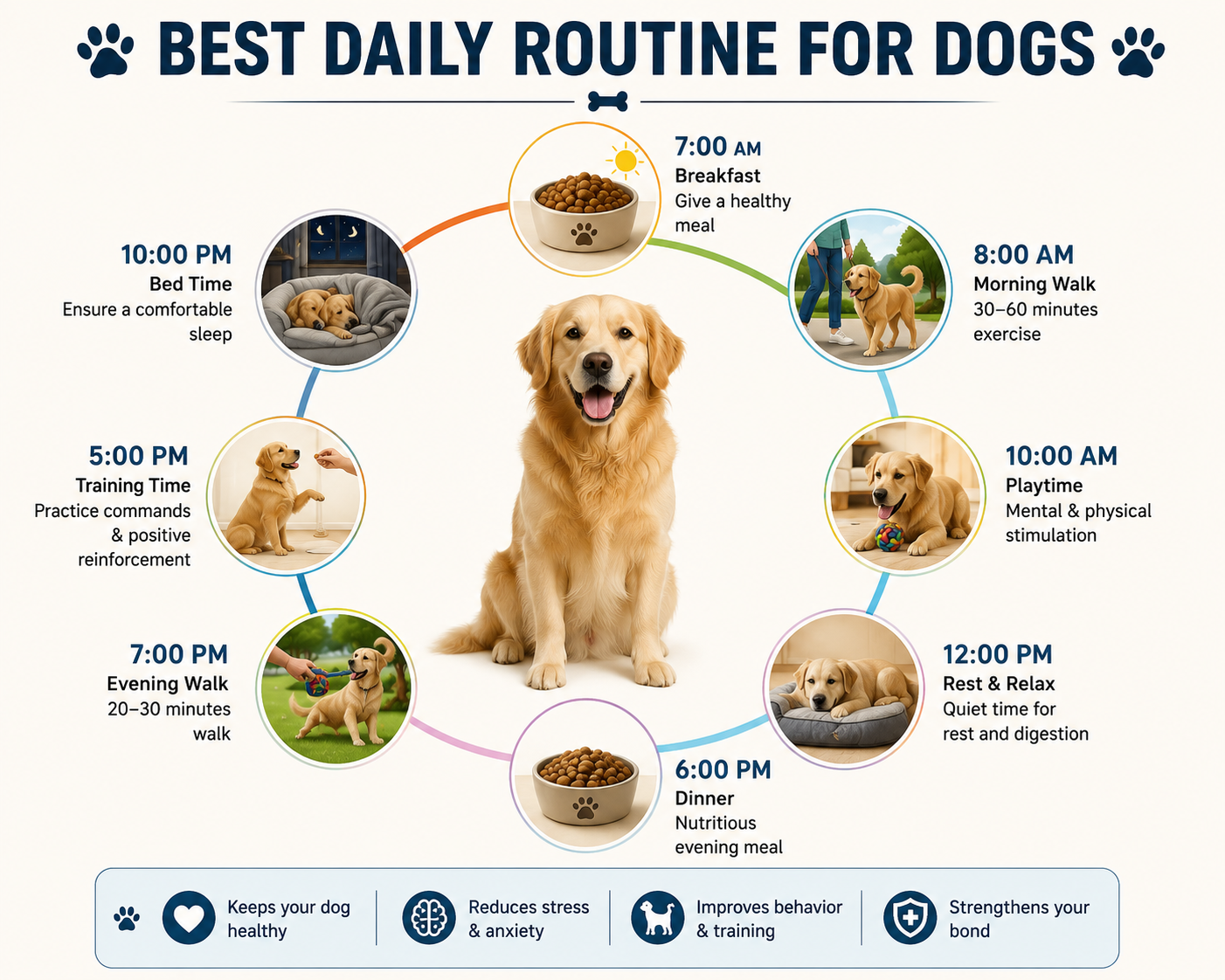
Best Daily Routine for Dogs
Use this schedule as a practical starting framework. Adjust times to fit your life and your dog’s specific needs based on their breed, age, and energy level.
| Time | Activity | Notes |
|---|---|---|
| 6:30 AM | Wake up and immediate potty break | First priority before anything else |
| 7:00 AM | Fresh water refill and breakfast | Consistent time daily |
| 7:30 AM | Morning walk | 20–60 min based on breed and age |
| 8:15 AM | Settle and quiet rest | Allow post-walk recovery |
| 10:00 AM | Play session or mental enrichment | Puzzle toy, short training, scent game |
| 12:30 PM | Lunchtime meal (puppies only) | Adult dogs skip this meal |
| 12:30 PM | Midday bathroom break | All dogs; more frequent for puppies |
| 1:00 PM | Rest and nap | Dogs sleep 12–20 hours daily |
| 2:00 PM | Training session | 5–10 min — short and focused |
| 3:30 PM | Mental enrichment or chew time | Rotate puzzle feeders and toys |
| 4:00 PM | Bathroom break | Check water bowl and refill |
| 5:30 PM | Evening exercise | Walk, fetch, yard play |
| 6:30 PM | Dinner | Second main meal |
| 7:00 PM | Post-meal rest | Allow digestion before vigorous play |
| 7:30 PM | Family time and bonding | Calm play, cuddling, companionship |
| 8:30 PM | Light walk or bathroom break | Wind-down outdoor trip |
| 9:00 PM | Grooming — brushing and dental care | Evening hygiene routine |
| 9:30 PM | Settle into sleeping area | Dim lights, reduce stimulation |
| 10:00 PM | Lights out | Consistent bedtime reinforces sleep rhythm |
This schedule reflects a typical workday household with an adult dog. Modifications for puppies, seniors, high-energy breeds, and varying work schedules are addressed in subsequent sections.
Morning Routine for Dogs
The morning routine is the most influential part of your dog’s day. What happens in the first 90 minutes sets the behavioral and physical tone for every hour that follows.
Morning Potty Break: This must happen first, before your dog eats, before you make coffee, and before any other interaction. A full bladder overnight means this is urgent. Take your dog to the same spot every morning — familiar scent encourages quick elimination and is especially valuable during house training.
Hydration: After the potty break, refresh the water bowl completely. Morning is when many dogs drink their most significant amount of water, having gone without overnight.
Breakfast: Feed the morning meal at a consistent time. Use measured portions rather than approximated amounts. After feeding, give your dog 20 to 30 minutes to begin digesting before the morning walk.
Walk: The morning walk is the most important exercise session of the day. It provides physical activity, environmental enrichment through scent exploration, social exposure, and the full elimination opportunity that a quick backyard trip cannot replicate. Allow your dog to sniff — sniffing is a primary cognitive activity for dogs, not an inconvenience.
Training: A five-minute training session after the morning walk capitalizes on your dog’s post-exercise alertness and willingness to engage. Practice a familiar command to build confidence, then introduce a new element to maintain engagement.
Playtime: A brief play session — five to ten minutes of tug, fetch, or chase — provides joyful interaction that strengthens your bond and gives your dog a positive note to settle into rest with.
Health Check: During the morning routine, quickly note your dog’s general condition. Is their gait normal? Are their eyes clear? Did they eat their full meal? This daily assessment takes sixty seconds and catches early changes that matter.
Afternoon Routine
The afternoon period, when many owners are at work or otherwise occupied, is where routine gaps most often develop. Addressing this gap is critical for dogs spending extended time alone.
Exercise: If possible, a midday walk or play session breaks the longest gap in the day and significantly reduces afternoon restlessness. If you work away from home, a dog walker or doggy daycare visit is a practical and worthwhile investment.
Interactive Toys: Before leaving for the day, set up a food-dispensing toy or puzzle that your dog can work through during the quiet afternoon hours. A frozen stuffed toy provides 20 to 40 minutes of sustained mental engagement.
Training: If you are home in the afternoon, a second short training session of five to ten minutes reinforces morning skills and maintains the learning momentum. Distributed training sessions across the day consistently outperform single long sessions.
Nap Time: The afternoon is a natural rest period for most dogs. Dogs sleep 12 to 20 hours daily, and much of this occurs in afternoon blocks. Provide a comfortable, quiet sleeping area and allow undisturbed rest.
Bathroom Break: Adult dogs can typically hold their bladder for four to six hours. A midday bathroom break at the four-hour mark prevents discomfort and supports house training consistency.
Hydration: Check the water bowl on any midday visit or after returning home. Active dogs drink substantially during warm weather and after play, and an empty bowl creates a preventable dehydration risk.
Evening Routine
Evening is typically when owners have the most available time for their dogs, and investing that time well pays significant behavioral dividends.
Dinner: Feed the evening meal at a consistent time, ideally between 5:30 and 7:00 PM. This spacing from the morning meal supports digestive rhythm. After the meal, allow at least 30 minutes of calm before vigorous activity, particularly for large, deep-chested breeds prone to bloat.
Walk: The evening walk serves a different purpose than the morning walk. Where the morning walk awakens and activates, the evening walk should begin moderately and wind down gradually. Finish the walk at a relaxed pace and allow extended sniff time as a calming conclusion.
Play: A play session after the evening walk, before the household fully settles, provides a final energy outlet and reinforces the social connection between dog and family.
Brushing: Evening brushing catches the day’s accumulated debris, checks for ticks or skin abnormalities, and for many dogs becomes a genuinely relaxing ritual. Match the brush and frequency to your dog’s specific coat type.
Dental Care: Brushing your dog’s teeth after the last meal of the day is the most effective timing — food sits on tooth surfaces overnight if not removed. Use a dog-specific toothbrush and enzymatic toothpaste. Even three to four evenings per week provides measurable dental health benefits over time.
Relaxation: Begin reducing household activity and stimulation about an hour before your dog’s target bedtime. Lower the lights, reduce noise, and transition to calm activities. Dogs read environmental cues and will begin settling naturally when the household winds down consistently.
Sleep Preparation: A final bathroom trip immediately before bed empties the bladder for the night. Place your dog in their sleeping area with a familiar blanket or worn item of your clothing, and maintain a consistent bedtime signal — the same phrase or gesture each night.
Daily Feeding Schedule
Feeding consistency is one of the foundational pillars of a healthy daily routine. Meal timing affects digestion, elimination predictability, energy levels, and appetite monitoring.
Puppies: Three to four meals per day until six months of age, then two to three meals until twelve months. Small, frequent meals match their small stomach capacity and rapid metabolism.
Adult Dogs: Two meals per day — morning and evening — approximately eight to twelve hours apart. This spacing supports digestive rhythm and allows for accurate appetite monitoring.
Senior Dogs: Two to three smaller meals per day. Senior digestive systems often process smaller, more frequent portions more comfortably. Some seniors with reduced appetite respond better to three smaller offerings than two larger ones.
Large Breeds: Large and giant breed dogs are often fed two meals of moderate size rather than one large meal to reduce bloat risk. This is particularly important for deep-chested breeds.
Small Breeds: Small breeds have higher metabolic rates and may benefit from two to three meals daily to prevent blood sugar fluctuations that can cause weakness in toy and miniature breeds.
| Life Stage | Meals Per Day | Timing | Key Consideration |
|---|---|---|---|
| Puppies (8–12 weeks) | 4 meals | Every 4–5 hours | Small portions, high-quality puppy food |
| Puppies (3–6 months) | 3 meals | Morning, midday, evening | Rapid growth phase |
| Puppies (6–12 months) | 2–3 meals | Morning and evening | Monitor weight closely |
| Adult Dogs (1–7 years) | 2 meals | Morning and evening | Measure portions consistently |
| Large Breeds | 2 meals | Morning and evening | Bloat awareness — no exercise immediately after |
| Small Breeds | 2–3 meals | Morning, midday, evening | Blood sugar stability |
| Senior Dogs (7+ years) | 2–3 meals | Spread evenly | Senior-specific nutritional needs |
Always provide fresh water alongside every meal and throughout the day.
Daily Exercise Routine
Exercise needs vary more significantly than any other element of a dog’s daily routine. Breed, age, health, and individual energy level all determine what is appropriate.
Walking: The foundation of most dogs’ daily exercise. Vary routes regularly to maintain mental engagement through new scent landscapes.
Running: Suitable for healthy adult dogs of appropriate breeds. Build running distances gradually to condition joints and cardiovascular systems properly.
Fetch: High-intensity cardiovascular exercise delivered efficiently. Limit repetitive throwing on hard surfaces to reduce joint strain.
Swimming: Excellent low-impact, full-body exercise particularly suited to dogs with joint conditions and senior dogs. Always supervise water activity and dry ears thoroughly afterward.
Puzzle Toys: Mental exercise is genuinely tiring for dogs. A challenging puzzle session supplements physical activity meaningfully and calms high-energy dogs beyond what physical exercise alone achieves.
Indoor Games: Tug, hide-and-seek, stair fetch, and scent games all provide physical and cognitive engagement during weather events or illness-related exercise restrictions.
| Dog Category | Daily Exercise | Activity Types | Key Notes |
|---|---|---|---|
| Puppy (under 4 months) | 5 min per month of age x 2 daily | Gentle play, short walks | Protect developing growth plates |
| Puppy (4–6 months) | 15–25 min twice daily | Leash walks, supervised play | Socialization focus |
| Small Adult Breeds | 20–30 minutes | Leash walks, indoor play | High metabolism, watch for overheating |
| Medium Adult Breeds | 45–60 minutes | Brisk walks, fetch, play | Highly adaptable group |
| Large Adult Breeds | 60–90 minutes | Running, swimming, hiking | High-energy breeds need more |
| Working/Sporting Breeds | 90–120+ minutes | Agility, scent work, running | Must include mental challenge |
| Senior Dogs | 20–40 minutes | Gentle walks, light play | Shorter, more frequent sessions |
| Giant Breeds | 45–60 minutes | Moderate walks, swimming | Joint protection priority |
Mental Stimulation Activities
Physical exercise tires the body. Mental stimulation tires the mind. Both are necessary for a genuinely satisfied, well-behaved dog.
Puzzle Feeders: Replace standard bowls with food-dispensing puzzles at meal time. Puppies and dogs new to puzzles start on easy difficulty. Experienced dogs can progress to multi-step puzzles that challenge problem-solving significantly.
Scent Games: Hide treats in multiple locations around the house or yard and let your dog find them using their nose. Fifteen minutes of structured scent work can have a calming effect comparable to a moderate walk for many dogs.
Training: Short, focused training sessions throughout the day provide cognitive engagement, reinforce communication between dog and owner, and build the behavioral skills that make daily life easier for everyone.
Chew Toys: Sustained chewing is cognitively engaging and self-soothing. Provide durable, size-appropriate chew toys and rotate them to maintain interest.
Interactive Toys: Tug ropes, flirt poles, and fetch games involve direct interaction with you, meeting social, physical, and cognitive needs simultaneously.
Food Enrichment: Frozen Kongs, lick mats, and scatter feeding in the yard extend mealtime from thirty seconds to twenty minutes, providing sustained engagement from food your dog eats anyway.
Learning New Tricks: Complex behaviors like roll over, weave through legs, fetch specific items by name, or tidy toys into a basket challenge memory, coordination, and impulse control. Dogs genuinely enjoy the clarity and reward structure that positive learning provides.
Daily Grooming Routine
Daily grooming is not about aesthetics. It is preventive health care performed every day with your hands.
Brushing: Match frequency to coat type. Short coats benefit from weekly brushing with daily checks. Long and double coats benefit from daily brushing to prevent matting and detect debris.
Eye Cleaning: Gently wipe any discharge from the inner eye corners with a damp cotton pad each morning. Use a fresh pad for each eye. Persistent or colored discharge requires veterinary evaluation.
Ear Checks: Look at your dog’s ears daily during petting and grooming. Note any redness, odor, or buildup. Clean gently with vet-approved solution and cotton pads weekly or as needed.
Dental Care: Brush teeth daily or as frequently as possible using dog-specific toothpaste and brush. The daily habit prevents the plaque accumulation that the American Animal Hospital Association identifies as one of the most prevalent preventable health conditions in companion animals.
Paw Inspection: After every outdoor outing, check paws for cuts, embedded debris, ice melt chemicals, and irritation between the toes. Apply paw balm seasonally for cracked or dry pads.
Skin Inspection: During brushing, part the fur and check for lumps, hot spots, rashes, fleas, or ticks. Early detection consistently improves treatment outcomes.
Coat Check: Assess coat condition daily during brushing. Changes in sheen, texture, or shedding pattern can indicate nutritional deficiency, hormonal changes, or underlying health conditions worth discussing with your vet.
Bathroom Schedule
Predictable bathroom schedules support house training, prevent discomfort, and provide early warning when gastrointestinal health changes.
Puppies: Need to go outside every one to two hours while awake, immediately after waking from naps, within 15 minutes of eating, after play, and before bed. Bladder control develops gradually — do not expect puppies to wait as long as adult dogs.
Adult Dogs: Most healthy adult dogs can comfortably manage four to six hours between bathroom breaks. A minimum of three to four outdoor opportunities daily is recommended — morning, midday, evening, and before bed.
Senior Dogs: Aging reduces bladder and bowel control. Senior dogs often need more frequent outdoor opportunities — four to five times daily — to prevent accidents that are distressing for them and frustrating for owners.
| Life Stage | Bathroom Breaks Per Day | Maximum Between Breaks | Key Notes |
|---|---|---|---|
| Puppies (8–12 weeks) | 8–10 trips | 1–2 hours while awake | After every meal, nap, and play |
| Puppies (3–6 months) | 6–8 trips | 2–3 hours | Bladder control improving |
| Puppies (6–12 months) | 4–6 trips | 3–4 hours | Gradually approaching adult schedule |
| Adult Dogs (1–7 years) | 3–4 trips | 4–6 hours | Morning, midday, evening, bedtime |
| Senior Dogs (7+ years) | 4–5 trips | 3–4 hours | More frequent; monitor for changes |
Any sudden increase in urination frequency, accidents by a previously house-trained dog, or straining during elimination warrants prompt veterinary evaluation.
Healthy Sleep Routine
Sleep is essential for physical restoration, cognitive processing, and emotional regulation in dogs. Creating the conditions for quality sleep is an active responsibility.
Recommended Sleep Hours: Adult dogs need 12 to 14 hours daily. Puppies need 18 to 20 hours. Senior dogs typically need 14 to 18 hours. These totals are distributed across nighttime sleep and multiple daytime naps.
Creating a Comfortable Sleeping Area: Provide a supportive bed in a quiet, draft-free location away from heavy foot traffic. Match bed type to your dog’s sleeping preferences and physical needs — orthopedic for large breeds and seniors, donut beds for dogs that prefer curled positions.
Bedtime Habits: Establish a consistent pre-sleep sequence — a final bathroom trip, a brief settling period in the sleeping area, and a consistent signal like a specific phrase or a light being turned off. Repeated nightly, this sequence becomes a powerful cue that sleep is expected.
Avoiding Sleep Disruptions: Keep the sleeping area quiet during rest periods. Avoid waking a sleeping dog unnecessarily. Provide adequate exercise during the day — dogs that do not expend enough energy have more fragmented, restless sleep at night.
| Life Stage | Total Daily Sleep | Nighttime Block | Daytime Naps |
|---|---|---|---|
| Newborn Puppies | 20–22 hours | Feeds every few hours | Almost continuous |
| Young Puppies (8–16 weeks) | 18–20 hours | With wake-ups | Multiple 1–2 hour naps |
| Adolescent Dogs (4–12 months) | 16–18 hours | Mostly continuous | 2–3 naps |
| Adult Dogs (1–7 years) | 12–14 hours | 7–9 hours | 2–4 shorter naps |
| Senior Dogs (7+ years) | 14–18 hours | Variable | Frequent shorter naps |
Daily Routine for Puppies
Puppies require the most intensive daily management of any life stage. Their schedules are driven by biology — tiny bladders, rapid growth, explosive learning windows, and enormous sleep requirements.
Feeding: Four meals daily until twelve weeks, three meals until six months, two to three meals until twelve months. Always use age-appropriate puppy food with AAFCO nutritional adequacy statement for growth.
Training: Begin immediately upon arriving home. Start with name recognition, sit, and come. Keep sessions to three to five minutes maximum — puppy attention spans are genuinely short. Multiple short sessions throughout the day are far more effective than one longer session.
Potty Breaks: Every one to two hours while awake, immediately after every nap and meal. Take your puppy to the same outdoor spot each time. Reward outdoor elimination immediately and warmly.
Naps: Puppies need a nap after every 45 to 90 minutes of waking activity. Respect this need — overtired puppies become hyperactive, nippy, and significantly harder to manage.
Play: Keep play sessions short, gentle, and varied. Introduce toys that encourage interactive play between you. Avoid rough play that rewards biting or jumping.
Socialization: Prioritize positive exposure to different people, surfaces, sounds, and environments during the critical socialization window between 8 and 16 weeks. This investment in early experience pays behavioral dividends across your dog’s entire life.
Daily Routine for Adult Dogs
Adult dogs between roughly one and seven years represent the most straightforward daily management challenge. Their routines are established, their needs are predictable, and they have the physical capacity for sustained exercise.
Focus on maintaining a consistent schedule that includes two substantial walks, two measured meals, a daily training session, adequate mental enrichment, and quality social time. Monitor weight regularly — this is when many dogs begin gradual weight gain that is easier to prevent than reverse. Continue annual veterinary wellness visits even when your dog appears completely healthy.
Daily Routine for Senior Dogs
Senior dogs need adjusted routines that honor both their continued engagement and their evolving physical limitations.
| Routine Element | Adult Dogs | Senior Dogs |
|---|---|---|
| Meals | 2 per day | 2–3 smaller meals |
| Walks | 45–90 minutes daily | 20–40 minutes in shorter sessions |
| Training | Daily — can be vigorous | Daily — gentle, familiar commands |
| Exercise type | Varied, can be high-intensity | Low-impact — walks, swimming, gentle play |
| Sleep | 12–14 hours | 14–18 hours |
| Bathroom breaks | 3–4 daily | 4–5 daily |
| Vet visits | Annual | Every 6 months |
| Grooming | Routine schedule | Gentle, monitor skin and coat closely |
| Mental enrichment | Challenging puzzles | Gentle scent games, familiar commands |
| Special considerations | Weight monitoring | Joint care, pain monitoring |
Adapting the Routine for Different Dog Breeds
Working Dogs: Border Collies, Belgian Malinois, and Australian Shepherds need two or more hours of combined physical and mental activity daily. Without sufficient engagement, they develop behavioral problems that no routine adjustment alone can resolve. Their schedule must include structured work or sport alongside standard care.
Sporting Dogs: Retrievers, Spaniels, and Pointers are built for endurance. Their daily routine should include vigorous exercise and activities that satisfy their retrieving or hunting instincts — swimming, fetch, and field work where possible.
Toy Breeds: Chihuahuas, Maltese, and Pomeranians have higher metabolic rates and may benefit from three small meals daily. Their exercise needs are moderate but real — daily walks remain important despite their small size.
Giant Breeds: Great Danes and Saint Bernards need moderate, controlled exercise rather than intensive running. Their routines should prioritize joint protection — softer surfaces, avoiding jumping, and monitoring for stiffness after activity.
High-Energy Dogs: Huskies, Jack Russell Terriers, and Dalmatians need routines that frontload their most vigorous exercise early in the day. Meeting their energy needs in the morning creates a calmer, more settled dog for the rest of the day.
Low-Energy Dogs: Basset Hounds, Bulldogs, and Shih Tzus need gentle encouragement to exercise adequately. Without structure, they may sleep through opportunities for beneficial activity. Routine scheduled walks ensure they stay mobile and maintain healthy weight.
Weekend vs Weekday Routine
One of the most common routine disruptions happens on weekends when owners sleep in, feed later, and walk at different times. For dogs, this is the equivalent of crossing multiple time zones twice a week — their bodies and behavior often reflect it.
The solution is not to have identical weekend and weekday schedules, but to maintain the structure’s rhythm even if the exact times shift. If you feed at 7 AM on weekdays, feed between 7 and 8 AM on weekends — not at 10 AM. If walks happen before breakfast on weekdays, maintain that sequence on weekends even if the timing shifts by an hour.
Consistency in sequence matters more than adherence to exact clock times. Your dog can adapt to a slightly later morning walk. What is genuinely disruptive is a schedule that changes its sequence and timing dramatically twice a week with no predictable pattern.
Common Mistakes Dog Owners Make
Skipping Walks: Treating walks as optional when time is short is one of the most frequent and consequential routine failures. Dogs that miss walks regularly develop behavioral problems that compound over time.
Inconsistent Feeding: Feeding at dramatically different times on different days disrupts digestive rhythm, creates irregular elimination patterns, and makes appetite monitoring less accurate.
Too Little Exercise: The minimum exercise for your dog’s breed and age is not the ideal — it is the floor below which problems develop. Aim for adequate, not minimal.
Too Much Exercise: Particularly harmful for puppies with developing growth plates, senior dogs with joint conditions, and brachycephalic breeds in warm weather. More is not always better.
Lack of Mental Enrichment: Owners who provide excellent physical exercise but zero mental stimulation often wonder why their dog is still restless and destructive. Both are necessary.
Poor Sleep Routine: Irregular bedtimes, disrupted rest periods, and inadequate total daily sleep accumulate into chronic fatigue that affects behavior, learning, and immune function.
Ignoring Bathroom Schedule: Dogs that are not taken outside often enough cannot succeed at house training. They are not stubborn — they are unsupported.
Printable Daily Dog Routine Checklist
| Task | Morning | Afternoon | Evening | Done |
|---|---|---|---|---|
| Potty break outside | Yes | Yes | Yes | |
| Fresh water refill | Yes | Yes | Yes | |
| Breakfast | Yes | |||
| Evening meal | Yes | |||
| Puppy midday meal | Yes | |||
| Morning walk | Yes | |||
| Evening walk | Yes | |||
| Training session (5–10 min) | Optional | Yes | Optional | |
| Play or enrichment | Yes | Yes | Yes | |
| Mental enrichment activity | Yes | |||
| Quick health check | Yes | |||
| Eye and paw inspection | Yes | |||
| Ear check | Yes | |||
| Brushing (coat type dependent) | Yes | |||
| Dental care | Yes | |||
| Medication (if prescribed) | Per schedule | Per schedule | Per schedule | |
| Pre-bed potty break | Yes | |||
| Settle in sleeping area | Yes |
Print this checklist and keep it in a visible location until your routine becomes automatic. Many owners find it useful to complete it for the first two to four weeks, then refer to it only occasionally as a maintenance check.
Frequently Asked Questions
What is the best daily routine for a dog?
The best daily routine includes morning and evening walks, two measured meals at consistent times, multiple bathroom breaks throughout the day, at least one dedicated training session, mental enrichment through puzzle toys or scent games, quality social time with the family, and a consistent bedtime routine. The specific timing and duration of each element should be tailored to your dog’s breed, age, and energy level.
How many times a day should I feed my dog?
Most healthy adult dogs do well with two meals daily, roughly eight to twelve hours apart. Puppies need three to four meals daily until six months of age. Senior dogs often benefit from two to three smaller meals. Always use measured portions and consult your veterinarian if you are unsure about appropriate quantities.
Is it okay to skip my dog’s walk sometimes?
Occasional missed walks due to illness or extreme weather are manageable for most dogs. Skipping walks regularly leads to weight gain, restlessness, destructive behavior, and elevated stress levels. Scheduled daily walks should be treated as a non-negotiable commitment.
How long should my dog’s daily walk be?
Walk duration depends on breed, age, and fitness. Small breeds generally need 20 to 30 minutes total daily. Medium breeds benefit from 45 to 60 minutes. Large and working breeds typically need 60 to 90 minutes or more. Your dog’s behavior at home — whether calm or restless — is a useful indicator of whether their current walk duration is sufficient.
Can routine reduce my dog’s anxiety?
Yes, significantly. Predictable routines lower baseline stress hormone levels in dogs by removing the uncertainty that drives anxiety. Dogs that know when their walk, meal, and quiet time are coming are measurably calmer than dogs in unpredictable environments.
Should my dog sleep on a schedule?
Dogs naturally regulate much of their own sleep, but establishing a consistent bedtime and protecting rest periods helps regulate their circadian rhythm. A consistent pre-bed sequence — final bathroom trip, settling in sleeping area, consistent lights-out signal — trains dogs to expect and accept sleep at regular times.
How often do dogs need mental stimulation?
Daily. Mental stimulation is not a supplement to physical exercise — it is an equal partner. Puzzle feeders, training sessions, scent games, and novel experiences should be incorporated into every day, not just on days when weather prevents outdoor exercise.
What time should I walk my dog?
Morning and evening are the most beneficial walking times for most dogs and owners. In summer, early morning and after sunset avoid peak heat. In winter, midday walks may be warmer and safer. The most important factor is consistency — walk at approximately the same times each day.
How many times a day should a puppy go outside?
Puppies need outdoor bathroom opportunities every one to two hours while awake, plus immediately after waking from naps and within 15 minutes of eating. In practical terms, this means 8 to 10 outdoor trips daily for young puppies. The frequency reduces as bladder control develops.
What if my schedule changes — how do I maintain routine for my dog?
Maintain the sequence of your routine even when exact timing shifts. If you feed at 7 AM on regular days, aim for 7:30 AM maximum on irregular days. Use dog walkers, doggy daycare, or trusted neighbors to fill significant gaps. Brief, consistent signals — the same words before walks, the same phrase before meals — help bridge timing variations.
How long should training sessions be?
Five to ten minutes per session is optimal for most adult dogs. Puppies benefit from three to five-minute sessions. Multiple short sessions throughout the day produce better learning outcomes than one long session. End every session on a successful, positive note.
Is a morning or evening walk more important?
Both serve distinct purposes and are ideally provided daily. The morning walk awakens, activates, and provides the first substantial elimination opportunity of the day. The evening walk burns remaining energy and winds the dog down for sleep. If only one walk is possible, morning is typically the higher priority for bathroom and behavioral settling reasons.
How do I build a routine for a newly adopted dog?
Begin your desired routine from the first day. Consistency establishes expectations faster than gradual introduction. Expect an adjustment period of two to four weeks as your new dog learns the schedule. Be patient with accidents, restlessness, and unsettled behavior — these typically resolve significantly as the routine becomes familiar.
Can dogs with medical conditions follow a standard routine?
With appropriate modifications, yes. Dogs managing arthritis, cardiac conditions, metabolic diseases, or post-surgical recovery need adjusted exercise duration and intensity, modified feeding schedules, and additional veterinary monitoring. Always consult your veterinarian before establishing a routine for a dog with known medical conditions.
What is the most important part of a dog’s daily routine?
Consistency across all elements is more important than perfection in any single one. A dog that receives adequate exercise, consistent feeding, regular bathroom access, daily social time, and protected sleep — even if each individual element is slightly imperfect — will be significantly healthier and better-behaved than a dog whose routine is excellent some days and nonexistent on others.
Final Thoughts
A great daily routine is not about rigidity. It is about reliability. Your dog does not need a militantly precise schedule — they need a predictable rhythm that meets their physical, cognitive, and emotional needs consistently enough that their nervous system can relax into it.
The schedule outlined in this guide provides a comprehensive framework, but every dog is different. A Border Collie needs a dramatically more intensive exercise and mental stimulation component than a Basset Hound. A twelve-year-old Labrador needs a fundamentally different approach than their two-year-old self. The health conditions, personality, breed characteristics, and life stage of your specific dog should always take precedence over any general framework.
What stays constant is the principle: dogs thrive when their world is predictable, their needs are met, and their relationship with their owner is consistent and positive. Start with the routine that makes most sense for your dog right now. Track what works and what does not. Adjust as your dog ages and their needs evolve. And when you are uncertain — about exercise levels, feeding quantities, or health-related schedule modifications — bring that conversation to your veterinarian.
The investment in building a great routine pays returns every single day. In a dog that settles easily, behaves predictably, sleeps soundly, and greets each morning ready for what they already know is coming. That kind of daily harmony is not just convenient for you — it is genuinely good for them.
References
- American Veterinary Medical Association (AVMA). Dog Care — Daily Health and Wellness. https://www.avma.org/resources/pet-owners/petcare
- American Animal Hospital Association (AAHA). Dental Care Guidelines; Canine Life Stage Guidelines. https://www.aaha.org/aaha-guidelines/
- Merck Veterinary Manual. Behavioral Problems of Dogs; Routine Health Care. https://www.merckvetmanual.com
- Cornell University College of Veterinary Medicine. Canine Nutrition and Exercise. https://www.vet.cornell.edu
- VCA Animal Hospitals. Dog Exercise and Daily Care. https://vcahospitals.com/know-your-pet
- World Small Animal Veterinary Association (WSAVA). Global Nutrition Guidelines. https://wsava.org/global-guidelines/global-nutrition-guidelines/
- American Kennel Club (AKC). Exercise Needs for Dogs; Dog Care Routines. https://www.akc.org/expert-advice/health/
- ASPCA. Dog Care — Daily Needs and Wellness. https://www.aspca.org/pet-care/dog-care
Author Bio
Written by the PetCareJournal Editorial Team
The PetCareJournal Editorial Team brings together experienced pet care writers, certified canine behavior consultants, and veterinary health researchers dedicated to producing accurate, practical, and trustworthy content for dog owners at every stage of their journey. Every article is developed using current veterinary science and reviewed against guidelines from leading animal health organizations. Our mission is to give every dog owner the practical knowledge they need to build a daily routine that genuinely supports their dog’s long-term health, happiness, and well-being.
Pet Care Disclaimer
The information provided in this article is intended for general educational and informational purposes only. It does not constitute professional veterinary advice, medical diagnosis, or treatment of any kind. Daily routine recommendations should be adapted to your individual dog’s specific needs, health status, age, breed, and veterinarian’s guidance. Always consult a licensed veterinarian before making significant changes to your dog’s diet, exercise routine, or daily care plan, particularly if your dog has a medical condition, injury, or special health requirement. In the event of a veterinary emergency, contact your veterinarian or the nearest emergency animal hospital immediately. The PetCareJournal Editorial Team and publisher accept no liability for actions taken based on the content of this article.